
Every week we get the same questions about laser hair removal, from salons that want to get started and from their clients. After fifteen years of adjusting lasers, explaining them and having the treatment ourselves (yes, us too), we know exactly where the confusion lies. Here are the answers, straight to the point.
So what does a laser like this actually do?
A diode laser sends light of one specific wavelength into the skin. That light is absorbed by the pigment at the base of the hair follicle and converted into heat. The heat damages the hair root, and a root that has been destroyed no longer produces a new hair. Put simply: the laser seeks out the dark hair, the root takes a hit, and after one to three weeks the hair falls out, root and all.
Diode or IPL: this is the difference
This is the question we end up talking about most often. IPL is not a laser but a flash of light with multiple wavelengths. It temporarily paralyses the hair follicle; you are rid of the hairs for a while, but they come back. A diode laser destroys the hair follicle. The result is lasting. Scientific research points to the diode laser as the technique with the best results for permanent hair removal, and we see that in practice every day.
Why four wavelengths?
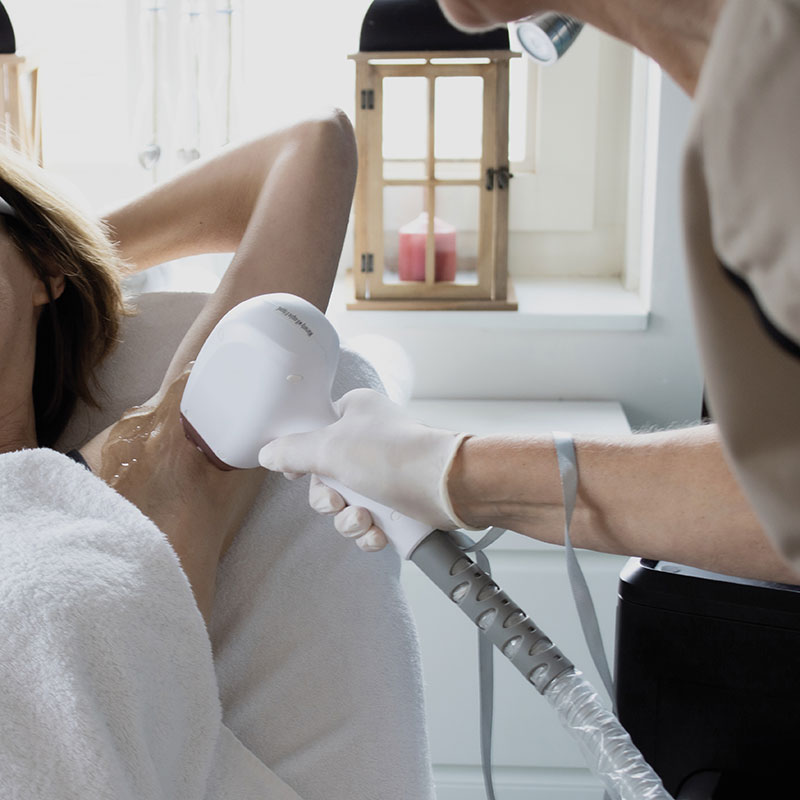
All our Diode ICE Lasers have 4 wavelengths: 755 (Alexandrite), 808 (Diode), 940 (the newest wavelength, which has no name) and 1064 (YAG) nm. Most professionals already know three of them from the Triple Wave. The fourth, 940 nm, is the clever addition: it ensures that the hair follicle is cut off from its nutrients, so that the follicle really dies off. More thorough and safer, and suitable for all skin types. The Royal Diode Ice Laser Quattro-PRO is our top model: super-fast, virtually painless and completely maintenance-free.
Does it hurt?
Not at all, or barely. The ICE cooling system cools the skin throughout the entire treatment. Clients describe it as little pinpricks. During menstruation the bikini line can be slightly more sensitive, but treatment can simply go ahead.
How many treatments are needed?
On average six to eight, with four to six weeks in between. There is a reason for that: the laser only catches hairs in the growth phase, because only then do they contain pigment. Per session you hit 10 to 30% of the active hairs. Count on 80 to 90% less hair growth after a full course. What remains is usually fine, light hairs that the laser does not see. One hundred per cent hair-free does not exist, with any method, and anyone who promises it is fooling you.
Blonde, grey or red hair?
White, grey or red hair contains no pigment, so there is little the laser can do with it. Blonde hair can be treated, provided it contains pigment. If your client has mainly dark hairs with the odd light one in between, you simply treat the area and deal with the rest later.
The practical rules
- Shave the day before with a simple razor, so that a little stubble is visible. No systems that first pull the hair out of the skin.
- Clean, grease-free skin on the day itself.
- No deodorant for 24 hours after the underarms; the chemicals irritate the skin.
- No hot showers, sauna, swimming pool or scrub for two days.
- Summer? Fine. Laser treatment in summer is just as safe and effective, as long as the client stays out of the sun for a while after the treatment.
And what about waxing?
Waxing is cheaper per visit, but you keep coming back, it hurts more and it takes more time. Worked out over a few years, laser is almost always the better deal. For your client and for your diary.
Want to know more about the Diode ICE 4-Wave Master or the Royal? Feel free to call us. We are happy to show you the device, and you can feel for yourself how the cooling works.